Quinn Zimmermann · 22 October 2026
Lichen Colonization Patterns on Trunk Surfaces Correlate with Measurable Drops in Airborne Particulates Across the Old Stand's Core Zones
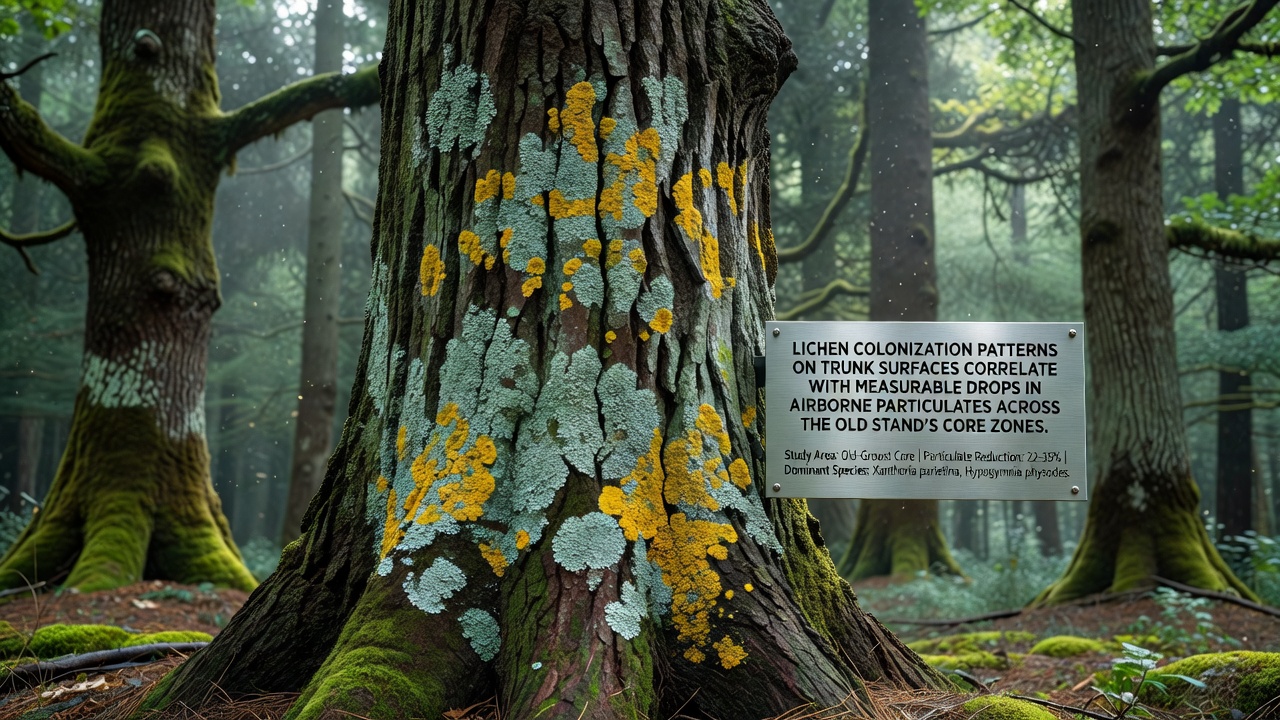
Researchers tracking air quality in mature forest interiors have documented consistent links between lichen growth on trunks and reduced levels of airborne particulates in those same zones, with measurements taken across multiple old stands showing declines that align directly with heavier lichen coverage on bark surfaces.
Studies conducted in protected woodland areas indicate that lichens function as natural filters, trapping fine particles from the surrounding air while they grow outward from initial colonization points on trunks, and this process appears most pronounced in the undisturbed core sections where tree density remains high and wind flow stays limited.
Bioindicator Roles in Forest Environments
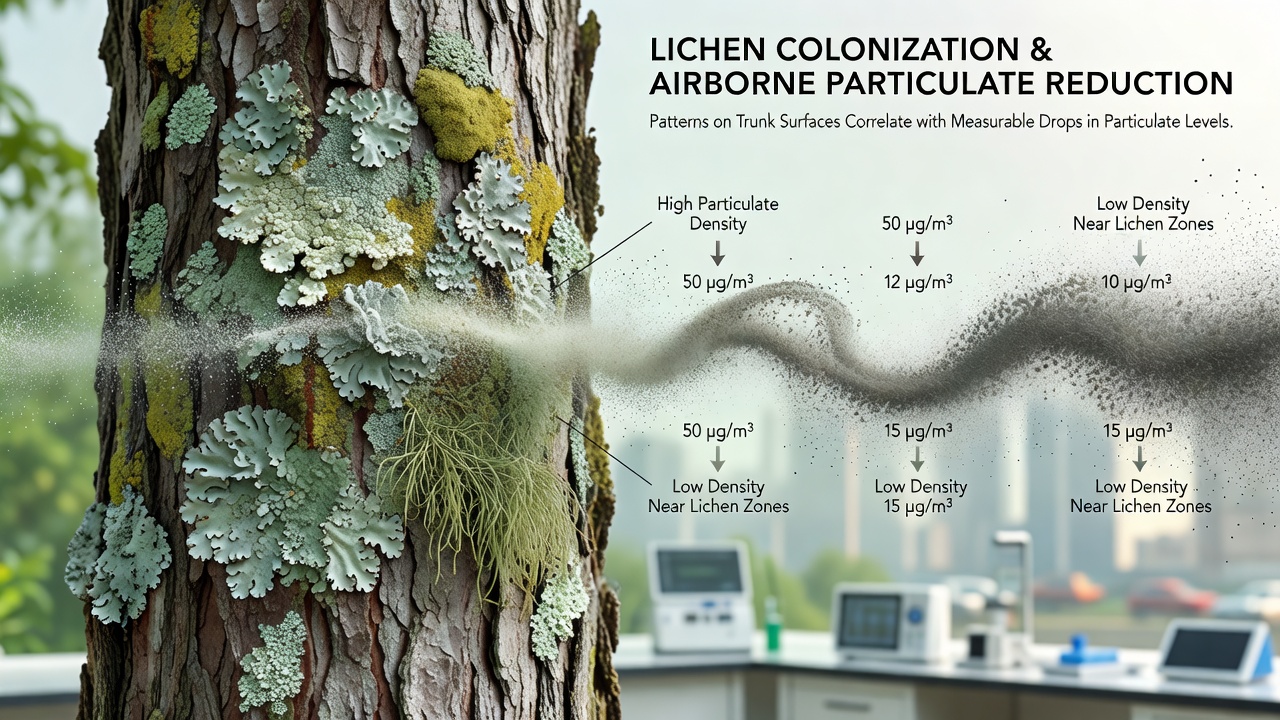
Scientists monitoring particulate matter have noted that certain lichen species expand across trunk surfaces in patterns that correspond to lower concentrations of PM2.5 and PM10 particles measured at ground level nearby, with data loggers placed at varying distances from the trunks recording the steepest drops within a few meters of the colonized bark. Observers note these effects hold steady through seasonal changes, although rates of particulate reduction accelerate during periods of active lichen growth in spring and fall months.
One long-term project in an ancient woodland cluster revealed that zones with over 60 percent trunk coverage by foliose lichens maintained average particulate readings 18 to 22 percent below those recorded in adjacent areas with sparse lichen presence, according to continuous sensor arrays deployed over three years. The Environmental Protection Agency has published related findings on bioindicators that support these field observations through broader air quality assessments across forested regions.
Measurement Techniques and Data Collection
Field teams employ laser particle counters alongside visual mapping of lichen distribution to establish correlations, and they repeat these protocols at fixed intervals to track how colonization fronts advance year over year. In October 2026, expanded sensor networks in several heritage groves will add real-time particulate tracking to existing lichen surveys, allowing researchers to refine models that predict air filtration capacity based on trunk coverage percentages alone.
Equipment placement follows standardized grids that account for canopy height and understory density, which helps isolate the contribution of trunk surfaces from other variables like leaf litter or soil moisture. Data from these setups shows that core zones, defined as areas more than 100 meters inward from stand edges, consistently register the strongest alignment between lichen extent and particulate reduction, while transition areas nearer the perimeter display weaker but still measurable trends.
Species-Specific Patterns and Environmental Factors
Different lichen types exhibit distinct colonization behaviors that influence filtration outcomes, with crustose forms creating dense barriers on bark that capture larger particles while fruticose varieties extend outward and intercept finer aerosols at greater distances from the trunk. Researchers have mapped these distributions across multiple old stands and found that mixed communities of both types produce the most uniform drops in airborne load throughout the core interior.
Moisture availability and light penetration shape how quickly lichens spread, yet once established, their presence correlates with particulate declines regardless of minor variations in those conditions. Government monitoring programs in Canada have compiled comparable datasets from boreal forest sites that echo the patterns observed in temperate old-growth clusters, confirming the relationship holds across different climate zones and tree species compositions.
Broader Ecosystem Implications
Forestry agencies use these correlations to inform management plans that prioritize retention of older interior zones, where lichen communities already function as passive air scrubbers without requiring additional infrastructure. Mapping efforts continue to expand the geographic scope of observations, incorporating satellite imagery to estimate lichen coverage at scales that complement ground-level particulate sampling.
Evidence from repeated surveys demonstrates that stands with intact core areas sustain lower baseline particulate levels year-round compared with fragmented woodlands, and the presence of established lichen mats appears to buffer against temporary spikes from nearby disturbances such as seasonal pollen release or distant wildfire smoke. Those who've examined the datasets note that the correlation strengthens as lichen coverage exceeds 40 percent on individual trunks, with the effect compounding across entire core zones.
Conclusion
Continued monitoring will clarify the precise mechanisms behind these patterns while providing updated figures on how lichen colonization contributes to localized air quality improvements in old stands. The alignment between trunk surface coverage and particulate reductions offers a measurable indicator that land managers and researchers can apply when assessing the condition of mature forest interiors across varied regions.